
How to Measure For Exterior Shutters
• Most exterior shutters are decorative, so sizing usually focuses on creating a realistic look.
• If you’re wondering how to measure for shutters, a good starting point is proportion.Decorative shutters typically look best when their width is about 25% to 33% of the full window width, including trim, while operable-looking shutters should be closer to half.
• For height, measure from the top to the bottom of the window trim and leave out the sill.
• If shutters will actually function, accurate measurements at multiple points and the right hardware setup are essential.
Step 1: Are the exterior shutters going to be functional or decorative?
Around 90% of all exterior shutters purchased will be installed in a manner that gives the appearance of functionality, but will never be closed over the window opening and therefore will not be functional.
The method used to measure for exterior shutters that function and the one used when the exterior shutters are not functioning, or fixed mount, are very similar. The biggest difference is that when exterior shutters swing open and close over a window opening, the width and lengths have to be precise. When the exterior shutters are going to appear to function, the authenticity of the shutter installation can be preserved while avoiding undue custom shutter charges.
Decorative Shutters
When measuring for decorative exterior shutters, it is always a good idea to have a goal for what you want to accomplish with adding exterior shutters to your home. Do you want an added sense of style and color? Do you want to enhance architectural details? Do you want decorative exterior shutters to look as if they are completely functional? Whatever your goal may be, a good starting point is to look around your neighborhood and take note what other homes of similar architectural style have done with their curb appeal; this will help you get an idea of what will work best for your home.
Operable Shutters
If the shutters are going to function, it is important to allow for hinges and spacing between shutters by subtracting clearances from opening width before calculating for exterior shutter width. Also, the exterior shutter must be the exact width or it might compromise the integrity of the shutters in order to function properly.
Step 2: Measuring for Exterior Shutters
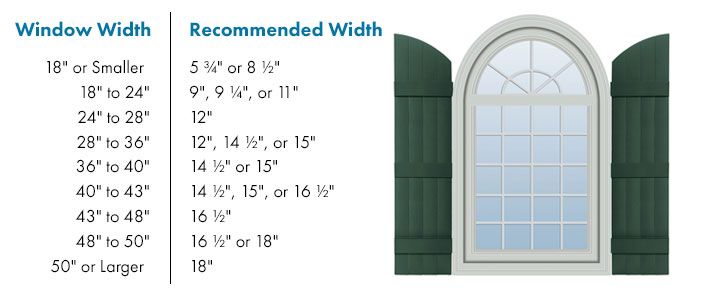

Shutter Width
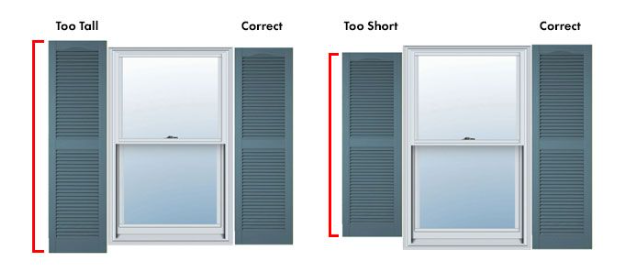
When selecting width, consider both the window size and spacing between openings. It is generally best to find a single number that works for all of your windows. The width that usually works best for decorative shutters is between 25% and 33% of the total width of your window, including the window trim. If the exterior shutters are not going to function, then you can decide which width and length you desire, using the table and pictures below as a guideline.
If you prefer to make your exterior shutters look operable, find a width that is close to 50% of the size of the glass and the window frame only, excluding the window trim. Make sure to measure the window vertically and horizontally to find the correct size.
Determining Shutter Height
For decorative shutters, height is typically measured from the top to the bottom of the window trim. If there is a sill at the bottom of the window, exclude its height from your measurements, as you want to maintain the appearance that the panels will close over the window.
How To Measure for a Precise Fit
Shutter Width
To determine accurate sizing, measure each window as if the panels will close over them. Take both the width and the height measurements at three different points, since most windows are not perfectly rectangular or square.
As shown in the diagram, measure the window at the top, middle, and bottom. If your three measurements are different, use the SMALLEST measurement. Divide this by two to give you the operable shutter width. For example, if your window width is 31" wide at its narrowest point, you should order 15 ½" wide shutters (31 ÷ 2 = 15.5). Traditionally, the method for determining shutter width is as follows:
Exterior Shutter Width = Opening Width - Clearances (if any) ÷ (# of windows × 2)

Measuring Height for Functional Panels
As shown in the picture, measure the window at three different points: left, middle, and right, disregarding any window sills, if you have one. If you have different measurements, use the SMALLEST of the three for your height measurement.

Step 3: What hardware is going to be used to install the custom exterior shutters?
If you want the shutters to be functional, it is important to determine what hardware will be used before taking final measurements. Understanding how hinges and mounting points affect spacing is key when learning how to measure for shutters correctly. The diagram below shows the most common exterior shutter installations.
Projected: The exterior shutters will function so that in the closed position, they will cover the opening. Notice that the pintle offset is greater than the other examples. This creates depth and allows the shutter to close without binding with the edge of the structure. The projected installation example is the easiest for measuring because there is no trim or structure to dictate the measurements.

Recessed: The panels will function so that, in the closed position, they will be between the trim all around the windows. Thus, the measurements must be made from the inside trim for width and height. It is important to recognize the depth created by the trim and the depth of the shutter might be greater than that of the trim alone. If this problem exists, then combining pintle and hinge offsets can create more depth, as in the projected example.

Flush: The exterior shutters are going to function so that, in the closed position, the outside edge of the shutters is flush with the surface of the structure. The measurement must be made between the inside edges of the opening of the structure for width and height. It is important to recognize the depth of the opening as the depth of the shutter might be greater than that of the opening. If this problem exists, then combining pintle and hinge offsets can create more depth, as illustrated here.

Final Tips for Measuring Exterior Shutters
If you’re learning how to measure for exterior shutters, this guide provides a reliable foundation for achieving accurate, well-proportioned results. For the best outcome, confirm your measurements carefully and consider professional installation for a seamless fit.For additional guidance or custom sizing, explore the selection at Hooks & Lattice or connect with our team to find the right solution for your home.
.